Metric
CLV/CAC Ratio
The value a customer brings over their lifetime compared with the cost of acquiring them.
Formula
CLV/CAC ratio=Customer lifetime value (contribution)Customer acquisition cost
Profit=Profit per customer × Acquired customers
What is CLV/CAC Ratio?
What the CLV/CAC ratio tells you about your business’s financial performance, what makes a ratio healthy or unhealthy, and how to improve it. This guide shows how to grow your bottom line by keeping customer acquisition costs in check and raising customer lifetime value.
The LTV/CAC ratio is a comparison between the value of a customer and the cost to acquire them. If the ratio is less than 1.0, the business is losing money, but if it is above 1.0, the company is making money. It’s not just about revenue, but the gross profit derived from each customer over their lifetime.
To accurately determine the value of each customer, calculate the Contribution Value by taking lifetime revenue and subtracting costs like Product Costs, Transaction Fees, Fulfillment Fees, Shipping Fees, and Taxes. This value represents the true contribution margin of the customer and is the “V” in the CLV ratio.
When calculating the Customer Acquisition Cost (CAC) for an ecommerce business, it’s important to note that this is not the same as Cost Per Acquisition (CPA) or Cost Per Order (CPO). Rather, CAC represents the cost per customer acquired. Calculating CAC allows you to measure the cost of acquiring a certain group of customers over a specific period of time.
When calculating LTV/CAC, it’s important to define what “lifetime” means for your business. Depending on the nature of the brand in terms of industry and how long you’ve been around, it can be interesting to monitor these ratios over varying “lifetimes” such as:
- Actual total lifetime
- 3 years
- 1 year
- 6 months
- 90 days
How to calculate CLV/CAC Ratio
If it costs €50 to acquire a customer, but that customer brings in €150 in value over their lifetime, then the LTV/CAC ratio would be 3.0.
CLV/CAC ratio=€150 ÷ €50 = 3.0
But just going for the highest CLV/CAC ratio isn’t always the best way to make the most profit. Consider a business acquiring 100 customers with a CLV of €200 and a CAC of €40: a CLV/CAC ratio of 5, €160 of profit per customer and €16,000 in profit.
| CLV | €200 |
|---|---|
| CAC | €40 |
| CLV/CAC ratio | 5 |
| Profit per customer | €160 |
| Acquired customers | 100 |
| Profit | €16,000 |
If the business increased its CAC to €100, they could acquire 250 customers per month, resulting in a CLV/CAC ratio of 2 and a profit per customer of €100, a decrease of 37.5%. However, the total amount of profit they could generate is up to €25,000, a 56% improvement.
| CLV | €200 |
|---|---|
| CAC | €100 |
| CLV/CAC ratio | 2 |
| Profit per customer | €100 |
| Acquired customers | 250 |
| Profit | €25,000 |
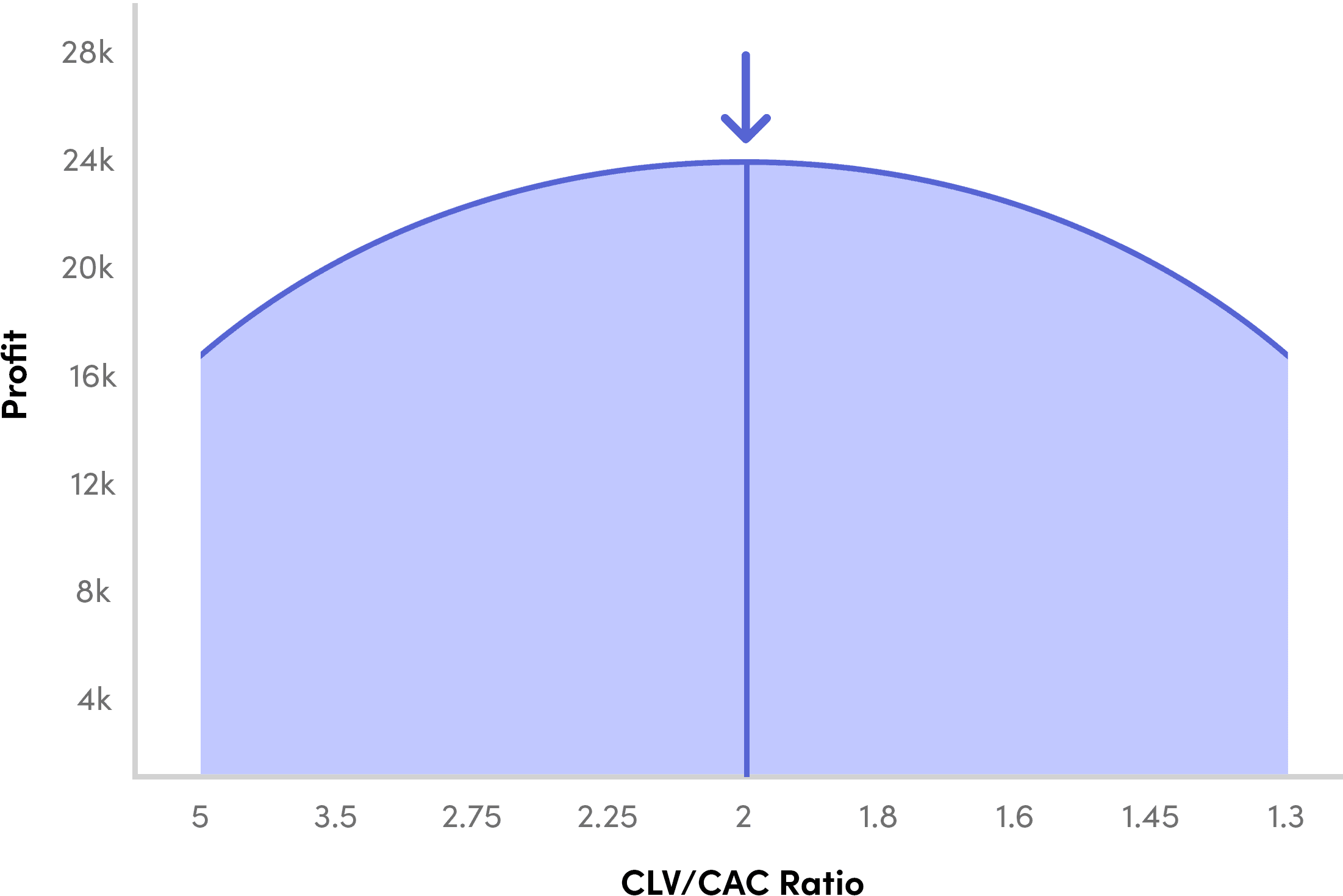
This assumes a perfectly correlated relationship between the growth in customers and the growth in CAC: increasing the number of customers you want to acquire by 10% will lead to a 10% increase in the average CAC for all customers.
Why it matters
Maximizing Customer Lifetime Value is key for businesses to sustain and grow in the long term. By focusing on LTV, businesses can make informed decisions about how to acquire and retain customers, and ensure they are generating enough value to sustain and grow their business in the long term.
CLV and CAC are measured at different times. CLV happens all the time, tracking sales and variable expenses for each order. CAC only happens when you get a new customer, measuring how much you spend on marketing to get them. When CLV is more than CAC, you make money from each new customer.
Many business owners are hesitant to increase their marketing spend due to the fear of rising CAC. But while it’s important to find the right CAC target, it’s not just about maximizing the CLV/CAC ratio. You also need to think about the context of your business, like how much you make from each sale and how your marketing spend affects your CAC. And if you make most of your money from customers after their first purchase, you have to take that into account when you calculate your CLV/CAC ratio.
Benchmarks
What is a good CLV/CAC Ratio?
Is your CLV/CAC Ratio higher than 3?
A good CLV/CAC Ratio typically varies based on industry and business model. However, as a general guideline, a CLV/CAC Ratio higher than 3 is considered favorable, and the ideal range is between 3 and 5. This means that the customer lifetime value exceeds the cost of acquiring that customer by at least three times. A higher ratio indicates that your business is generating significant long-term value from each customer and that your customer acquisition efforts are cost-effective.
What is a bad CLV/CAC Ratio?
Is your CLV/CAC Ratio lower than 1?
A bad CLV/CAC Ratio is typically below 1. This means that the cost of acquiring a customer exceeds the value that customer brings to your business over their lifetime. A low CLV/CAC Ratio indicates that your business may be struggling to retain customers or that the average customer lifetime value is significantly lower than the cost of acquisition. It is essential to identify the reasons behind a low ratio and implement strategies to improve customer retention, increase customer lifetime value, or optimize your customer acquisition costs.
How to improve CLV/CAC Ratio
- Enhance customer retentionFocus on building strong relationships with your existing customers to increase their lifetime value. Offer personalized experiences, excellent customer service, and loyalty programs to encourage repeat purchases and foster long-term loyalty.
- Increase customer lifetime value (CLV)Explore ways to maximize the value each customer brings to your business. This can be achieved through upselling and cross-selling strategies, introducing premium products or services, or extending customer engagement through subscriptions or memberships.
- Optimize customer acquisition costs (CAC)Evaluate your marketing and advertising channels to ensure you are targeting the right audience efficiently. Experiment with different acquisition channels, optimize your campaigns, and refine your targeting to minimize acquisition costs while maintaining quality leads.
- Improve customer satisfactionDeliver exceptional customer experiences and exceed expectations at every touchpoint. Happy and satisfied customers are more likely to become repeat customers and recommend your business to others, contributing to higher CLV and a more favorable CLV/CAC Ratio.
- Focus on long-term relationshipsInstead of solely focusing on short-term sales, prioritize building long-term relationships with your customers. This may involve nurturing leads, providing ongoing value through content and education, and maintaining consistent communication to stay top-of-mind.
- Continuously analyze and optimizeRegularly analyze your CLV/CAC Ratio and track key metrics related to customer acquisition and retention. Use data insights to identify areas for improvement, test different strategies, and optimize your efforts based on what works best for your business.
Frequently asked questions
What is the CLV/CAC Ratio?
The CLV/CAC (or LTV/CAC) ratio compares the value of a customer over their lifetime with the cost to acquire them. Below 1.0 the business is losing money on each customer; above 1.0 it is making money.
How do you calculate the CLV/CAC Ratio?
Divide customer lifetime value, measured as contribution (lifetime revenue minus product costs, transaction, fulfilment and shipping fees and taxes), by customer acquisition cost. €150 of lifetime value and a €50 CAC give a ratio of 3.0.
What is a good CLV/CAC Ratio?
As a general guideline, a ratio higher than 3 is considered favorable, and the ideal range is between 3 and 5.
What is a bad CLV/CAC Ratio?
A ratio below 1 means the cost of acquiring a customer exceeds the value that customer brings over their lifetime.
Is a higher CLV/CAC Ratio always better?
No. Spending more to acquire more customers lowers the ratio but can raise total profit. In the example, moving from a ratio of 5 (100 customers, €16,000 profit) to a ratio of 2 (250 customers) takes profit to €25,000, a 56% improvement.
Is CAC the same as CPA?
No. Cost Per Acquisition (CPA) and Cost Per Order (CPO) are costs per order; CAC is the cost per new customer acquired over a period.
Calculators and further reading
Start your free 14 day trial
Get a demo and see how our unified e-commerce dashboard can help grow your store, profitably.