MER vs ROAS: Why Ecommerce Founders Should Track MER/aMER
Return on Ad Spend (ROAS) looks simple: revenue ÷ ad spend per campaign. But it’s channel-specific, attribution-dependent, and often misleading. For a deeper dive see our blog: The Problem with ROAS: why it’s blocking your Shopify growth.
- Attribution issues → Privacy changes and multi-channel journeys make it hard to know which campaign “deserves” the credit.
- Narrow view → A campaign might show 6× ROAS but only because it’s targeting existing customers — not driving new growth.
- Scaling blind spots → ROAS can look healthy even as overall profitability erodes when spend increases.
That’s why leading DTC brands are shifting to more holistic metrics like MER and aMER.
As Shopify explains in their recent post Marketing Efficiency Ratio: How To Calculate + Improve MER,
“MER reflects the impact of branding efforts, organic traffic, influencer partnerships, and awareness campaigns. MER gives business owners a truer sense of overall marketing profitability and sustainability. ROAS may fail to represent the complete picture by only focusing on ad spend.
MER provides a more holistic understanding of the costs associated with all marketing activities involved in attracting and converting customers.”
What is MER in Ecommerce?
Marketing Efficiency Ratio (MER) = Total Revenue ÷ Total Ad Spend.
It’s sometimes called “blended ROAS” because it looks at all of your revenue against all of your marketing spend, not just a single campaign or channel.
- Example: $150k revenue ÷ $50k ad spend = MER of 3.0×.
Why this number matters
MER gives you the big-picture view of marketing efficiency. Instead of getting caught in the weeds of channel reporting or attribution debates, it answers the higher-order question:
- For every dollar we spend on marketing, how many dollars of revenue does the business generate overall?
This matters because attribution is getting harder, and campaign-level metrics (like ROAS) can be misleading. MER cuts through the noise by measuring outcomes at the business level.
We also featured MER as one of the 7 key metrics your ecommerce dashboard should have.
The role of MER in scaling decisions
On its own, MER won’t tell you which campaign is working best. But that’s not its job. MER is a guardrail metric: it tells you whether your total marketing investment is aligned with profitable growth.
- If MER is rising, it means your marketing is becoming more efficient at driving revenue overall.
- If MER is falling, it signals that your spend may be outpacing the return, even if individual campaigns still look good.
The caveat: blended revenue
Because MER includes all revenue, both new and repeat customers, it can hide acquisition inefficiency. That’s why MER should always be paired with aMER (more on that below).
- MER shows the overall efficiency of your marketing spend.
- aMER shows whether new customers are being acquired profitably.
Together, they give you the clearest picture of whether your business is scaling sustainably.
In StoreHero
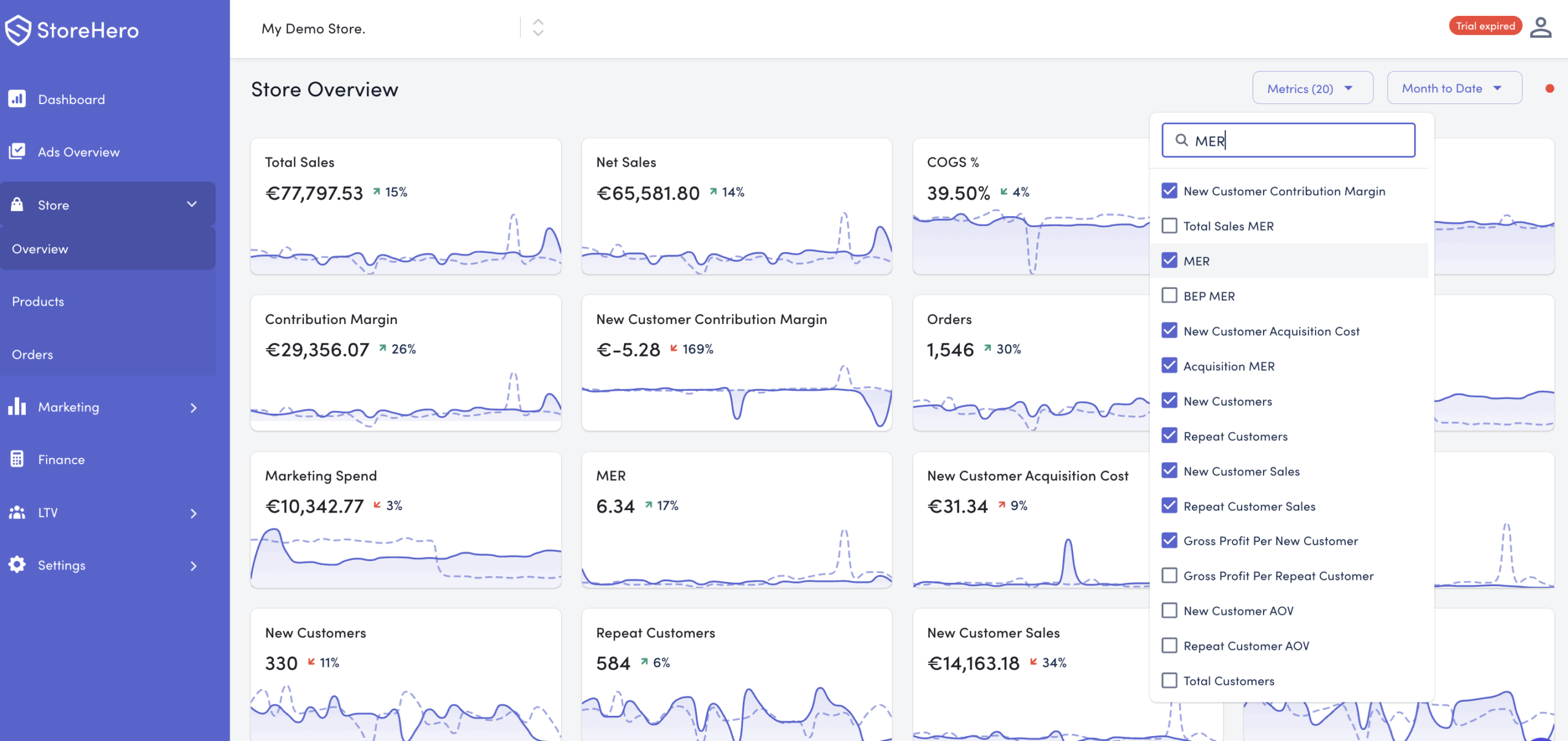
Top tip: You can find MER right in your StoreHero dashboard after logging in.
Or go to:
Store → Store Overview → Add Metrics → Scroll down and toggle on MER & aMER.
What is aMER (Incremental MER)?
Acquisition MER (aMER) = New Customer Revenue ÷ Total Ad Spend.
It isolates the efficiency of your ad spend at driving first-time customer purchases, not just total revenue.
- Example: $50k ad spend / $25k new-customer revenue = aMER of 0.5×.
Why this number matters
aMER exists because not all revenue is created equal. Repeat buyers are valuable, but they don’t require the same acquisition investment as new customers. If you judge efficiency on total revenue alone (MER), you risk hiding inefficient acquisition behind loyal customers who would have purchased anyway.
aMER forces you to ask:
- Are we buying growth or just recycling revenue?
- Is our next ad dollar actually profitable in bringing in net-new customers?
- At what point does spending more stop making sense?
The tradeoff between volume and efficiency
As you increase ad spend, efficiency usually declines. aMER shows you that tradeoff: higher spend might bring in more new customers overall, but often at a worse return per dollar.
That’s why aMER is a better indicator of sustainable scaling. It helps identify when you’re in the “sweet spot” where new customer growth is still profitable, versus when you’ve crossed into diminishing returns.
Beyond the average: marginal aMER
Looking only at your blended aMER (all new customer revenue ÷ all spend) can also be misleading. What really matters is marginal aMER — how much revenue your next dollar of spend produces.
- If your blended aMER is 2.0×, you might think you’re safe.
- But if your marginal aMER has already fallen below breakeven (say, <1.5× on a 70% margin), then every new dollar is losing money.
This is the real power of tracking aMER: it tells you not just how efficient you were, but whether you should keep scaling spend going forward.
MER vs ROAS: Key Differences Explained
ROAS can be directionally useful, but it’s narrow: it focuses on the efficiency of a single campaign or channel, and relies heavily on attribution. MER and aMER widen the lens to measure whether your marketing spend is actually moving the business forward profitably.
| Metric | Focus | Best For |
|---|---|---|
| ROAS | Campaign or channel-level returns | Creative testing, tactical optimisation |
| MER | Total revenue vs total spend | Strategic efficiency of all marketing |
| aMER | New-customer revenue vs total spend | Profitability of scaling growth |
Why this matters
- Guardrails for spend: MER and aMER tell you how much you can spend while staying profitable. They answer the CEO/CFO question: “Are we growing the business sustainably?”
- ROAS in context: ROAS helps you decide which campaigns or creatives to invest in, but it only makes sense when framed within MER and aMER. A great ROAS campaign might still harm overall profitability if aMER is weak.
- Profit over clicks: ROAS can make a campaign look like a success when in reality you’re overspending to reacquire existing customers. MER and aMER cut through that noise by tying spend back to business outcomes — revenue growth and profitability.
- Scaling decisions: MER shows whether marketing is efficient overall; aMER shows whether new customer growth is sustainable. Used together, they help you decide when to scale, when to pause, and how to balance acquisition with retention.
In short:
- MER = overall business efficiency guardrail
- aMER = acquisition profitability test
- ROAS = campaign dial
When you view them together, you move from chasing “good-looking numbers” to making decisions that keep growth profitable in the long run.
How to Use These Metrics
- Check MER monthly → Are you hitting your revenue efficiency target?
- Check aMER monthly → Are new customers being acquired profitably?
- Layer in margins → A 3× MER is only good if your gross margins support it.
- Scale confidently → If aMER holds while spend rises, you’re growing sustainably.

Closing Thoughts
ROAS will always have its place for campaign-level optimisation, but it’s no longer enough to guide real growth decisions. In a world where attribution is unreliable and scaling spend can quietly erode profitability, relying on ROAS alone risks giving you the wrong signal.
That’s why leading DTC brands now use MER and aMER as their true north metrics. MER shows the overall efficiency of your marketing machine, while aMER reveals whether your growth is actually being fueled by profitable new customers. These should be held in tandem with your contribution margin goals, which is the profit after this marketing budget! Together, they answer the only question that matters: are we spending to grow profitably, or just spending more to look bigger?
Inside StoreHero, you don’t need to build these metrics from scratch. Your MER and aMER targets are already forecasted and benchmarked using our simple forecast builder, so you can see at a glance if you’re on track, ahead, or drifting off course. That means less time buried in spreadsheets and more time making confident decisions about when to scale, when to optimise, and when to protect margin.
The bottom line: ROAS tells you if an ad worked; MER and aMER tell you if your business is working.
A “good” MER varies by margin profile, growth stage and industry; many sources suggest ~3× to 5×+ for DTC brands.
MER = Total Revenue ÷ Total Ad/Marketing Spend
aMER = New Customer Revenue ÷ Total Ad/Marketing Spend (first-time customer revenue only)
ROAS typically measures revenue from a specific ad or channel ÷ spend on that ad/channel. MER is broader: all revenue ÷ all spend across marketing.
Because MER includes both new + repeat customers, you might have a healthy MER even if you’re inefficient at acquiring new customers, hence the need for aMER.
Use MER as a strategic guardrail: “Are we efficient overall from a business standpoint?”
Use aMER as a growth-profitability test: “Are we acquiring new customers profitably?” Is our aMER over our BEP ROAS/MER
Marginal aMER looks at the additional revenue generated by the next dollar of ad spend. It’s crucial for answering: “At what point does our next ad dollar stop making money?”
You should be monitoring MER and aMER daily to stay close to performance trends. However, that doesn’t mean you should be making changes every day. In most cases, use daily monitoring for awareness and only act if you see major unexpected changes. For strategic decision-making (like scaling spend or adjusting targets), a weekly or monthly review cadence is usually the right pace.
A “good” MER or aMER only matters if your margin structure supports it, if margins are low, you’ll need a higher MER/aMER to stay profitable.
No, while ROAS is useful for tactical campaign optimisation, it doesn’t show whether your marketing spend is profitable at the business level or whether new customers are being acquired efficiently.
StoreHero automates the tracking of MER & aMER, lets you set target forecasts and benchmarks, giving you a live dashboard you can monitor instead of building spreadsheets from scratch.
While MER and aMER can be calculated manually from Shopify and ad platform data, the process is time-consuming and often inaccurate. The best approach is to use a tool that centralises your ecommerce, marketing, and finance data in one place. Platforms like StoreHero automatically calculate MER and aMER, benchmark them against your forecasted targets, and layer in contribution margin so you can see whether growth is truly profitable. This removes the need for spreadsheets and ensures your decisions are based on live, accurate numbers.