Wooho, another Meta Andromeda Update in 2025! Don’t worry, this one isn’t an iOS14-level meltdown that keeps media buyers awake at night.
Meta quietly rolled out its Andromeda update in late 2024 and into early 2025. Unlike some past platform shifts, this isn’t about losing data or blowing up your targeting overnight – but it does mark a real change in how ads get delivered.
Andromeda is Meta’s new ad-retrieval engine, and while it won’t spark panic in your boardroom, it does mean businesses need to rethink how they approach creative.
What Is Andromeda?
Meta defines Andromeda in very technical terms that sound impressive but aren’t exactly advertiser-friendly. In their March 2025 blog, they described it as:
“An innovative end-to-end hardware, software, machine learning co-designed system introduced in 2024, with Meta Training and Inference Accelerator (MTIA) and NVIDIA Grace Hopper Superchip. This more efficient system enabled a 10,000x increase in the complexity of models used for ads retrieval, the first step in the ranking process where we narrow down a pool of tens of millions of ads to the few thousand we consider showing someone.”
If your eyes glazed over reading that, you’re not alone.
Here’s what it really means:
- Andromeda is about retrieval. It’s the first stage of ad delivery where Meta decides which ads even have a shot at being shown.
- It doesn’t pick the winning ad; it builds the shortlist.
- It was designed to fix the bottleneck caused by Advantage+ and AI flooding the system with more creative variations than the old retrieval architecture could handle.
Meta explains it with an analogy: imagine a personal concierge who doesn’t just know you like shoes, but knows you love red flip flops for the beach. In the past, you might have been lumped into a generic “shoe lover” bucket. Now, Andromeda aims to deliver the ad that fits your exact taste and context.
The bottom line: Andromeda is Meta’s new retrieval engine. It takes millions of ads, narrows them to a few thousand candidates, and does so in a way that’s faster, smarter, and more personal than before.
How Ads Were Judged Before
Previously, Meta advised advertisers to run just 3–6 ads per ad set
- The algorithm relied heavily on manual audience targeting and campaign structure.
- Over time, advertisers consolidated spend around one or two ‘winner’ ads, while the rest quickly starved.
- Meta’s system often treated slight copy tweaks or small visual changes as sufficient ‘variation.’
As a result, this approach put more emphasis on campaign setup and targeting precision than on creative diversity.
How Andromeda Changes the Rules
Retrieval at Scale
Andromeda enhances the “retrieval” phase, meaning a much larger pool of creative options can be considered before ranking and delivery.
Creative Diversity Matters
Minor edits no longer cut it. To succeed, advertisers now need to produce distinct concepts:
- Different hooks, stories, and motivators
- A mix of formats (video, carousel, static, reels)
- Creative built for different personas and funnel stages
Best practice is shifting from a handful of ads to 8–15 unique concepts per campaign.
Broader Targeting, Simpler Campaigns
Because the retrieval engine does more of the matching, advertisers can:
- Target more broadly, rather than over-segmenting audiences
- Run fewer ad sets with larger creative libraries
- Lean into automated campaign types like Advantage+
Performance Impact
Meta has already reported measurable improvements in ad quality. But it’s worth remembering: Andromeda doesn’t create good ads for you. However, if your creative is weak, the system can’t compensate. Strong creative is now the critical driver of performance.
Why Creative Similarity Matters More Than Ever
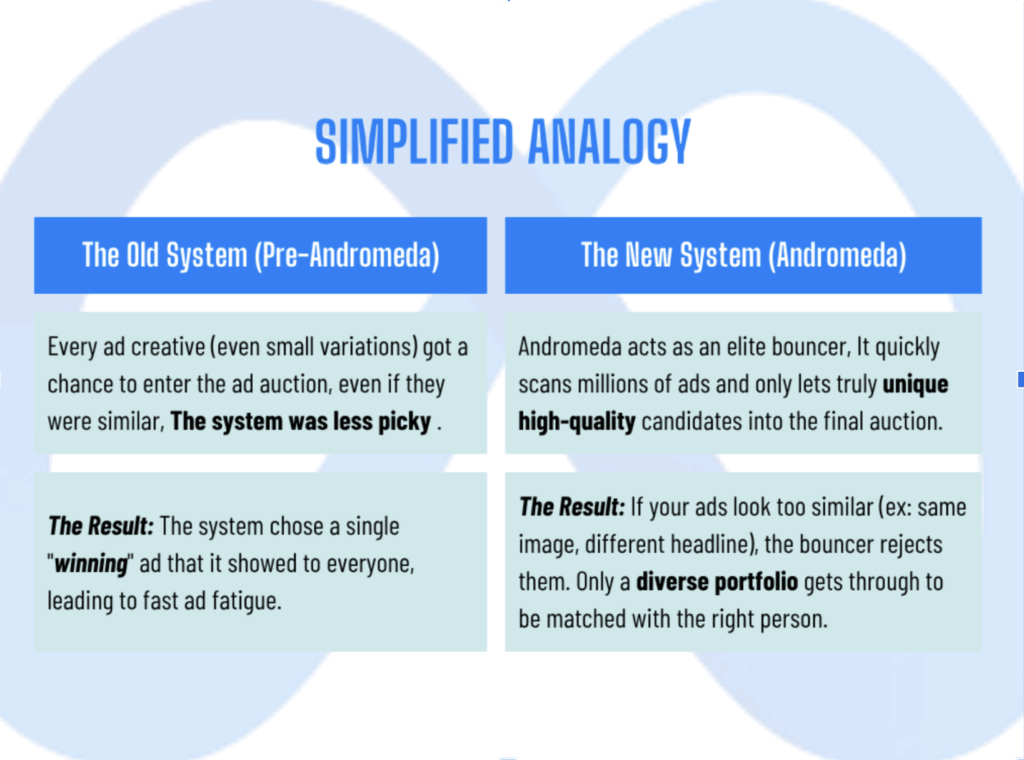
One of the clearest signals we’ve seen from Meta workshops and audits is that Andromeda is far stricter in how it evaluates creative similarity.
There are real cases where ads with entirely different people, scripts, and edits were still grouped as the same ad simply because they shared similar setups — like the same creator type or background environment.
This shows that Andromeda isn’t just analysing your words. It’s pattern-matching visual cues.
What that means in practice:
- Same creator in the same setting = same ad
- Tweaks to copy or overlays = not recognised as new
- Visual similarity can override narrative difference
So it’s no longer about churning out “more ads” – it’s about building truly different ads.
Meta’s own research backs this up: “Different motivators unlock new audiences 89% of the time.” In addition, persona-based creative lasts longer and performs better because it reaches new audience segments instead of oversaturating the same ones.
How advertisers should adapt:
- Take bigger creative swings after finding a winner – change locations, settings, and formats to avoid similarity penalties.
- Use hook variation (the first 3 seconds) to redefine the ad for a fresh audience.
- Recycle winning ads with new b-roll to extend their lifespan.
- Bake persona insights directly into briefs – focus on different motivations, not just new product angles.
To reinforce this shift, Meta is rolling out a Creative Similarity Report, highlighting:
- Creative Fatigue – when audiences burn out on ads
- Creative Similarity – when too many assets look alike
- Top Creative Themes – the broader trends driving engagement
The message is clear: scaling under Andromeda requires not just volume, but meaningful variety in story, setting, and structure.
How to Measure Creative Success Under Andromeda
If the way ads are retrieved has changed, so should the way we measure them. Here are the core metrics brands should focus on now:
1. Early Engagement Signals
Andromeda cuts underperforming ads faster, so initial traction matters.
- CTR (Click-Through Rate)
- Thumbstop / 3-second view rate
- Engagement (likes, shares, comments)
These tell you if an ad has the strength to survive the retrieval filter.
2. Creative Fatigue Indicators
Meta will now expose fatigue more clearly.
- Frequency – how often the same users see an ad
- First-Time Impression Ratio – how much reach is going to new people
- CPC / CPA trends over time – rising costs can signal fatigue or similarity penalties
3. Creative Diversity & Reach Unlocks
Look at whether new creatives are unlocking new audiences.
- Number of unique audiences reached per creative
- Impression spread across creatives (not just one winner soaking all the spend)
- Overlap penalties – ads treated as duplicates
4. Motivator & Persona Performance
- Which angles (price, quality, lifestyle, social proof, urgency) are unlocking incremental sales?
- Which personas are resonating best?
- LTV by motivator – are certain creative concepts driving higher-quality customers?
5. Business-Level Profitability
At the end of the day, creative exists to drive business results.
- MER (Marketing Efficiency Ratio) / Blended ROAS
- New Customer Acquisition Cost (nCAC)
- Gross Profit per Order
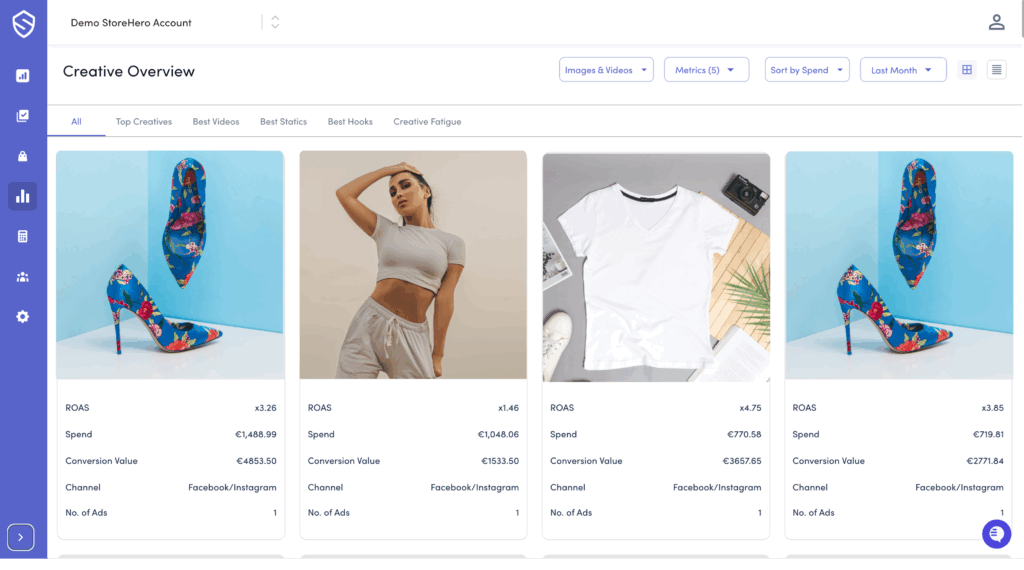
💡 Pro Tip: All of these metrics can be tracked inside the StoreHero Creative Overview, which gives you a single view of creative performance across channels. Instead of jumping between Ads Manager reports, StoreHero lets you see which creatives are driving engagement, unlocking audiences, and contributing to profit.
See how Sean from Fíor used the Creative Overview to over 10x Sales!
Be sure to check out 7 Key Insights on Meta’s Andromeda Update: Why It’s Flipping Facebook Ads Upside Down (And How to Adapt)
Another great resource here from the team at Smart Marketer – Andromeda: How Meta’s New Update Quietly Transformed Facebook Ads (and What to Do Now)
Final Takeaway
Andromeda is more than a backend update. It’s a signal that Meta’s ad ecosystem is moving towards creative-led growth.
The brands that thrive will be those that adapt their creative strategy, iteration process, and measurement framework to match. If you focus on diversity, motivator-based creative, and profitability metrics, Andromeda can become an advantage rather than a hurdle.
In Meta’s words, it’s an “innovative end-to-end hardware, software, machine learning co-designed system” that uses things like the Meta Training and Inference Accelerator (MTIA) and the NVIDIA Grace Hopper Superchip.
In human language: Andromeda is Meta’s new ad-retrieval engine. It’s the stage before ranking, where the system filters millions of ads down to a shortlist. Think of it as the bouncer at the club deciding who even gets inside — ranking happens later.
Good news: it’s not. iOS14 broke tracking and data attribution. Andromeda doesn’t touch your reporting. Instead, it changes how Meta decides which creatives get delivered. This is a structural shift in how ads are retrieved – not a data privacy apocalypse.
Because the old retrieval system was choking. Advantage+ campaigns and AI have created an avalanche of new ad variations, and Meta’s older infrastructure just couldn’t process them fast enough. Retrieval was the bottleneck, and Andromeda fixes it.
You uploaded 3–6 ads per ad set, segmented audiences tightly, and hoped the algorithm would pick a winner. Usually one ad soaked up the budget and the rest died quickly. Minor copy tweaks or swapping a background were often enough to count as “new.”
Creative variety > copy tweaks. You need distinct concepts, not just reskins.
Similarity penalties are real. Two different ads that look visually alike may be treated as one.
Broader campaigns work better. The system is built to handle matching; you don’t need to over-engineer targeting.
Andromeda is looking at visuals, not just text.
Same creator + same setup = same ad.
Slight copy changes don’t register as new.
Overlapping backgrounds or scenes can override different scripts or edits.
Forget the old 3–6 limit. The sweet spot is 8–15+ distinct creative concepts per campaign. The keyword here is distinct — totally different hooks, settings, or personas.
It’s no longer about micro-differences in CTR between two near-identical ads. Instead, track:
Early engagement signals: CTR, thumbstop, 3-second view rate
Fatigue indicators: frequency, first-time impression ratio, rising CPC/CPA
Creative diversity: are multiple ads winning, or is one soaking all the spend?
Motivator performance: which angles unlock new audience segments
Business outcomes: MER, nCAC, and gross profit per order
💡 Pro tip: You can see all of these in one place inside the StoreHero Creative Overview, without bouncing between Ads Manager reports.
Depends on your creative strategy.
If you’ve relied on a single “hero” ad with endless tweaks → it’s bad news.
If you’re building creative variety and testing different motivators → it’s great news.
Bottom line: Andromeda rewards meaningful creative diversity. The brands that adapt will win cheaper reach, fresher audiences, and better long-term performance.