
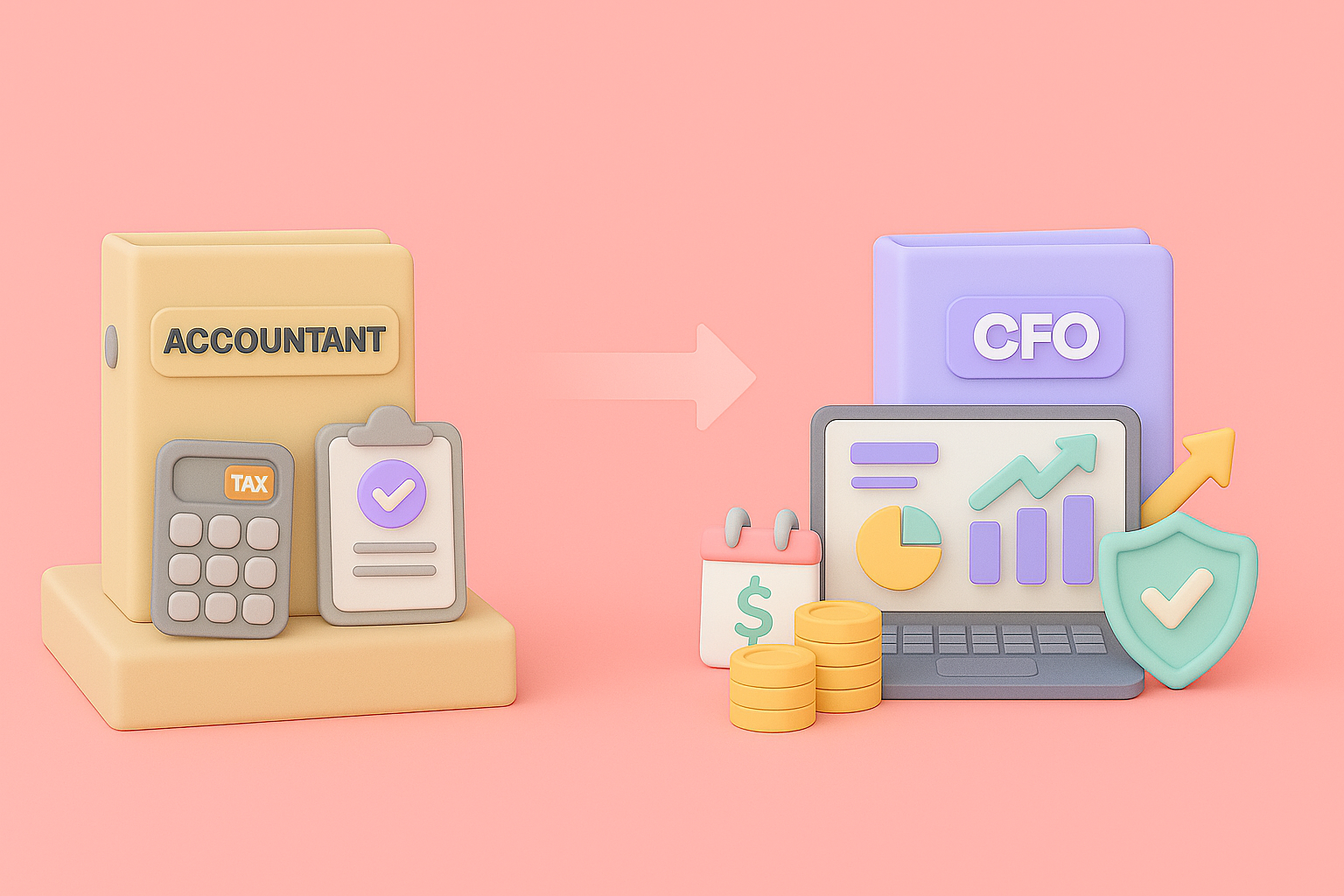
Why Most DTC Brands Outgrow Their Accountant
Most eCommerce founders start with the accountant down the road. They’ll file your taxes, reconcile Shopify payouts, and send a clean month-end report.
But ask them what your ideal CAC should be to maintain a 20% margin, and you’ll get silence.
That’s not their fault. They’re not built for eCommerce.
Your brand doesn’t just need financial reporting. You need a true eCommerce finance strategy, someone who speaks Shopify fluently, understands how ad spend flows through your P&L, and can connect the dots between inventory turns, cashflow timing, and profit.
That someone is a CFO.
What Does an eCommerce CFO Actually Do?
An eCommerce CFO isn’t just a finance manager, they’re the strategist who turns your data into a single, profitable story.
They build one source of truth for your business: where your marketing performance, inventory, and cashflow all align around your goals, risk tolerance, and growth ambitions.
A good CFO helps you answer the bigger questions:
- How much can we safely spend on ads this month without breaking cashflow?
- Do we need external financing to scale, and if so, is it a bank loan, revenue-based financing, or an equity raise?
- How fast can we turn our inventory into cash and reinvest in growth?
They don’t just report what happened, they help you plan what’s next.
Here’s what that looks like in practice:
- Cashflow forecasting for inventory buys and ad spend cycles.
- Margin analysis by product, channel, and cohort, so you know exactly where profit compounds.
- Scenario planning to model best, worst, and expected outcomes before you scale or throttle ad budgets.
- Profit forecasting and rolling 13-week cashflow models that show how your decisions play out in real time.
- Financing strategy whether to fund growth through working capital loans, revenue-based financing, or equity, and what each means for your risk and runway.
- Investor-ready reporting if you plan to raise capital or sell, clear, credible numbers that tell your growth story with confidence.
An eCommerce CFO isn’t just managing money. They’re managing momentum, helping you grow faster, profitably, and with total financial clarity.
Why an Accountant Isn’t Enough for eCommerce
Most accountants are compliance-oriented: their job is to keep you legal, accurate, and on time.
But eCommerce runs on speed and foresight, not just accuracy.
An accountant can tell you what happened.
A CFO tells you what to do next.
And here’s the danger, if you take strategic advice from someone who doesn’t understand eCommerce dynamics, you’re flying blind.
DTC is a numbers game wrapped in a marketing cloak.
You’re spending significant amounts of money on ads, often weekly. That’s not just a marketing decision, it’s a financial decision.
If your bookkeeper or accountant doesn’t understand cash conversion cycles, ad spend lingo, contribution margin, or inventory turnover, they might unknowingly steer you toward over-spending (and burning cash) or under-spending (and stalling growth). Neither is a good outcome.
The flip side (we see this play out all the time)? Many brands then swing the other way, taking ad spend guidance solely from their digital marketing agency.
That’s also risky. Your agency usually doesn’t know your cash position, inventory days on hand, or risk tolerance. They’re optimizing for ad efficiency, not for financial health.
A great CFO sits between both worlds, translating marketing data into financial clarity. They’ll tell you when to push, when to pause, and how to keep profit compounding while you grow.
We see this all the time:
- A $5M DTC brand still relying on a local accountant who also handles cafés and law firms.
- A marketing team scaling spend aggressively with no cashflow guardrails.
It’s not about effort.
It’s about expertise, and perspective.
What’s the Difference Between an Accountant and a Fractional CFO?
| Function | Accountant | Fractional eCommerce CFO |
|---|---|---|
| Primary Role | Compliance & tax | Strategic finance leadership |
| Focus | Accuracy & reporting | Profitability & growth |
| Time Horizon | Looks backward | Looks forward |
| Typical Output | P&L, balance sheet, reconciliations | Financial models, forecasts, KPIs |
| Key Question | “Did this get recorded right?” | “Can we afford to increase ad spend next month?” |
| Engagement | Monthly or quarterly | Ongoing, high-impact strategy |
A fractional CFO gives you the insight of a senior finance leader, without the full-time cost.
They’ll work directly with your marketing and operations teams to align spend, cashflow, and inventory decisions around profitability.
What Kind of Advice Can an eCommerce CFO Give?
A good eCommerce CFO doesn’t just analyze, they advise.
They help you make real-time calls on:
- Ad Spend: “Should we double Meta spend next month, or will that choke cashflow?”
- Inventory: “What’s the reorder timing that keeps us in stock without locking up cash?”
- Pricing: “Does our AOV and repeat rate justify a price bump?”
- Profit Forecasts: “If we hit our revenue target, what’s the net profit after fulfillment and fees?”
- Channel Decisions: “Is Amazon actually profitable after fees and FBA?”
They don’t replace your accountant, they direct the entire financial playbook.
CFO vs. Marketing Agency: Who Should Dictate Ad Spend?
Agencies talk in ROAS.
CFOs talk in profit and cashflow.
A marketing agency might say:
“Your ROAS is 3x, let’s scale!”
A CFO will ask:
“At 3x ROAS/MER, what’s your net margin after shipping, fulfillment, and returns?”
It’s not the same question, and it leads to a completely different decision.
A CFO knows ad spend isn’t a marketing decision. It’s a cashflow and profitability decision. That’s why they build guardrails, not arbitrary budgets.
Instead of saying,
“We’ve got $50,000 to spend on ads this month,”
they’ll say:
“We need to hit a contribution margin target of $125,000. Based on past performance, that likely means spending around $150,000 at a 3x MER. In fact, we should keep scaling as long as we stay above that 3x threshold, because every $ above it compounds profit.”
That’s the CFO mindset:
- Spend confidently within defined profit guardrails.
- Protect cashflow while maximizing growth.
- Avoid both overspending (which kills runway) and underspending (which leaves money on the table).
Meanwhile, your agency is optimizing for ROAS. Your CFO is optimizing for return on cash.
A strong eCommerce CFO understands cash payback periods, blended CACs, and gross margin impact before approving ad budgets.
That’s how you move from spending to grow → to investing to compound.
When Should You Hire a CFO (or Fractional CFO)?
You don’t need a CFO from day one.
But there’s a moment in every eCommerce brand’s growth where your gut stops being enough, and the financial questions start piling up.
You’ll know you’re there when you keep asking questions like these 👇
1. “We’re growing, but where’s the money going?”
Sales are up, campaigns are converting, yet cash isn’t stacking. That’s usually a sign your gross margin is eroding somewhere in the mix: fulfillment costs creeping up, discounting eating into profit, or ad spend outpacing contribution margin growth.
A CFO will trace every $ through your P&L to show where margin leaks occur, then build the model to fix it.
Because “more revenue” only matters if it turns into more cash in the bank.
2. “Can we actually afford to increase ad spend next month?”
Your agency says, “ROAS looks great, let’s scale!”, but your gut says cash is tight. That tension is a CFO’s sweet spot.
They’ll map ad spend against your 13-week cashflow, expected payback period, and contribution margin target. You might discover you can scale, but need to delay 10 days until inventory lands — or that your blended MER needs to stay above 3x to protect margin.
A CFO doesn’t kill growth, they set guardrails that let you scale confidently, not recklessly.
3. “Why does cash always feel tight, even when sales are strong?”
That’s the hidden weight of eCommerce, you’re buying inventory weeks before you see revenue, while platforms like Meta and Google bill instantly.
A CFO models your cash conversion cycle, showing how long it takes every dollar to travel from ad click to bank account. Then they build a cash buffer or financing plan to close that gap.
Because it’s not enough to be profitable on paper, you need liquidity in real life.
4. “Are we funded correctly for our next move?”
Maybe you’re eyeing a big inventory buy or new channel launch — but not sure how to fund it.
A CFO helps you weigh options: a bank loan for stability, revenue-based financing for flexibility, or an equity raise if you need a long runway. Sometimes, the right answer isn’t new debt or equity, it’s unlocking liquidity from your own supply chain through tools like invoice financing. Each has trade-offs around control, cost, and cashflow impact.
The right choice depends on your goals, margin profile, and risk tolerance, and your CFO’s job is to make sure the math and mindset align.
5. “Do I actually trust the numbers I’m looking at?”
Shopify says one thing, your accountant says another, and your ad platform reports a different reality altogether.
A CFO creates a single source of truth, unifying sales, marketing, and finance data so you can see exactly what’s happening across the business.
When you know your data is clean, your decisions get sharper, and your team stops wasting time reconciling spreadsheets.
6. “Why can’t my accountant explain what’s really happening?”
If your accountant says “you had a good month” but can’t tell you why cash dropped or margin dipped, it’s not their fault — they weren’t trained for DTC dynamics.
A CFO lives in the details that matter: ad spend pacing, returns impact, inventory turn, and CAC payback. They connect these daily drivers to your P&L and balance sheet.
That’s how financial clarity turns into competitive advantage.
Pro Tip:
If you’re under $3-5M in revenue, start with a fractional eCommerce CFO, someone who can help you professionalize your finance, model scenarios, and build your cash discipline.
Beyond that, or if you’re running multiple channels, financing growth, or managing high inventory turnover, it’s time for a dedicated CFO.
The Playbook: Start by Asking Better Questions
Every great CFO relationship starts with better questions — the kind that force clarity and reveal where your blind spots really are.
Here’s where to start this week 👇
1. Do we truly understand our profit drivers?
What products, channels, or cohorts actually generate profit — not just revenue?
If you can’t answer that confidently, your “growth” might just be churn in disguise.
2. Are we scaling with visibility — or guessing with optimism?
Before increasing ad spend, can you see the cashflow impact 30, 60, and 90 days out?
If not, build a simple rolling cashflow model (or get a CFO to help you). Guesswork kills momentum.
3. Are marketing and finance looking at the same truth?
If your ROAS dashboard says “scale” but your P&L says “ouch,” it’s time to connect them.
Centralizing finance + marketing data into one view turns confusion into confidence.
4. Do we have the right financial setup for our stage?
If your current system stops at bookkeeping + tax, you’ve got compliance — not strategy.
You don’t need a full-time CFO yet, but you do need someone asking these questions regularly.
5. What decisions am I making from instinct, that should be informed by data?
That’s your first CFO hire checklist.
Think Like a CFO, Scale Like a Founder
Growth gets noisy fast.
But the right questions create clarity.
A CFO doesn’t just manage numbers, they bring a discipline of thinking that turns chaos into compounding.
At StoreHero, we’ve seen it again and again: the moment a founder starts asking CFO-level questions, the business changes.
That’s why we built StoreHero, to help you see your true profit story in real time, even before you hire one.
And if you’re at the stage where you’re looking for a CFO or fractional CFO, we work with some of the best in the industry., and we’re happy to make a personalized recommendation based on your business size, vertical, geography, and timezone.
An accountant looks backward, they record, reconcile, and report. A CFO in ecommerce looks forward, they model, plan, and guide.
In eCommerce, that means an accountant might tell you what your profit was, while a CFO tells you what your profit could be next quarter, and how to get there.
You need both, but you grow faster when they work together.
If your accountant is delivering accurate books and clean reports, that’s great, but it’s not strategy.
When you’re spending heavily on ads, managing inventory cycles, and planning for growth, you need someone who can interpret those numbers in real time.
That’s where a CFO comes in, to turn financial reporting into decision-making.
Most DTC brands start feeling the need around $1M–$5M in revenue, when decisions about ad spend, inventory, and cashflow become too complex for part-time bookkeeping.
A fractional CFO gives you senior-level expertise without a full-time salary.
They’re perfect for bridging that middle stage, when you need financial leadership but aren’t ready for a permanent hire.
Agencies optimize for ROAS, CFOs optimize for cashflow and contribution margin.
They’ll set performance guardrails (like a target MER or CAC payback period) so you know exactly when to scale or pause.
It’s not about spending less, it’s about spending intelligently within profit boundaries that compound.
Absolutely, because they remove guesswork.
A CFO shows you where margin compounds, helps you model scenarios, and ensures every new dollar of ad spend or inventory buy pushes profit, not just revenue.
Growth with clarity moves faster than growth with chaos.
A great CFO evaluates all funding options: bank loans, revenue-based financing, equity raises, or even invoice financing for short-term cashflow support.
They’ll map how each affects ownership, runway, and repayment risk, so you’re not guessing or over-leveraging.
They build rolling cashflow forecasts — usually 13 weeks ahead, that show when money enters and exits your business.
This lets you predict crunch periods, plan ad spend around payouts, and avoid emergency credit.
Think of it as night vision for your bank balance.
A great CFO tracks the metrics that move profit — not just fill dashboards.
They’ll monitor gross and contribution margin, CAC, MER, LTV:CAC, inventory turnover, inventory days on hand, and cash conversion cycle to manage operational efficiency.
Then layer in operating cashflow, EBITDA margin, working capital, and burn rate to track financial health.
The goal isn’t to report, it’s to connect numbers to decisions that compound profit.
Profit is what’s left on paper after sales and expenses.
Cashflow is what’s actually in your account when you need it.
In eCommerce, timing gaps between ad spend, payouts, and inventory can make you profitable but cash-poor, a CFO’s job is to bridge that gap so you can scale safely.
StoreHero connects your marketing, sales, and finance data in one place — so you can see your true profit story in real time.
It gives you the visibility a CFO would want, even if you haven’t hired one yet.
And if you are looking for a CFO, we work with some of the best in the industry and can make a personalized introduction based on your size, industry, and timezone.