
Why Your Tracking Is Probably Broken (and Why That Matters)
You’re probably wasting money on ads, not because your creative is bad, but because your tracking is lying to you.
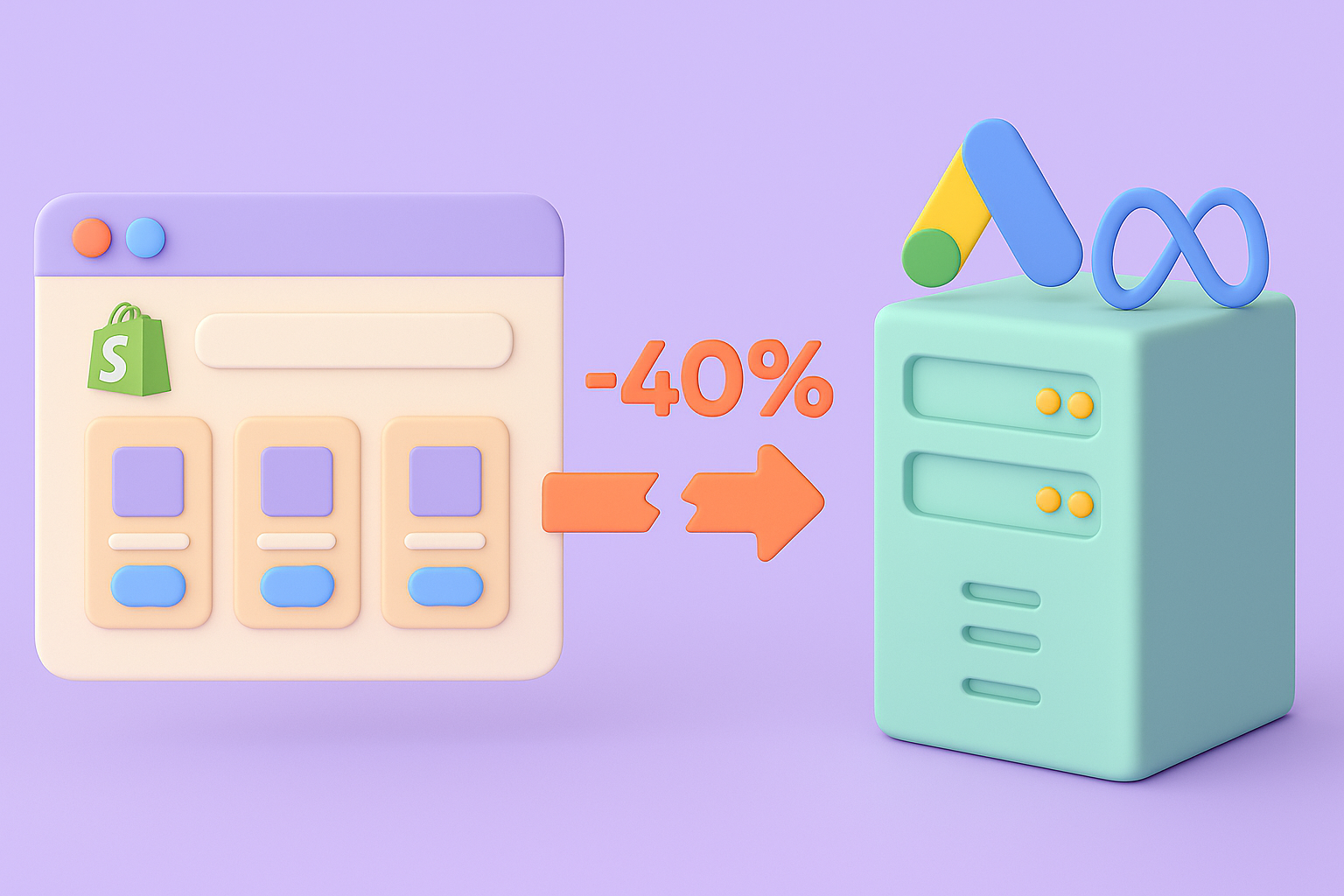
If you’re running Meta or Google Ads for your Shopify store, you might assume every click, visit, and purchase is being tracked. In reality, up to 40% of your conversion events never make it back to those ad platforms. That means your ROAS looks worse than it really is, your algorithms are optimizing blind, and your “growth ceiling” is being set by broken data.
TL;DR: Most Shopify brands are missing up to 40% of their conversion data because browser-based tracking is breaking down, thanks to privacy updates, cookie limits, and ad blockers. Server-side tracking fixes that by sending clean, complete conversion data directly from your store to Meta and Google. The result: truer ROAS, stronger optimization, and up to 40% more efficient ad spend.
In 2025, pairing server-side tracking with a profit platform like StoreHero is the smartest move a scaling DTC brand can make, and chasing shiny attribution tools before fixing your data foundation is a waste of time.
In this guide, we’ll explain why browser-based tracking is failing Shopify brands, how server-side tracking fixes the leak, and why you shouldn’t spend a cent on attribution tools until you’ve fixed your signal flow.
Let’s break it down simply, what server-side tracking actually does, why it matters, and how it can make your existing ad spend dramatically more efficient.
If you’re using Meta Ads, Google Ads, retargeting, and you’re sending traffic into Shopify, you assume you’re capturing the data flow: click → visit → conversion → profit. But in reality, the journey is leaking.
Here’s what’s going on:
The weak link: browser-based tracking & tag-and-pixel hand-offs
Historically, platforms like Meta and Google rely on browser-based tracking (via pixels, tags, cookies) to pass data back to your store or your analytics. That might mean: a visitor clicks an ad, gets a cookie (gclid(google), fbclid (meta) etc), browser loads your website, the pixel fires, a purchase happens and the pixel reports the data.
But that hand-off has problems:
- Ad blockers, browser privacy protections, third-party cookie blocks, intelligent tracking prevention (ITP) all reduce the number of events that make it through.
- The user might drop off before the “thank you” page loads (so purchase is missed). Check out What Shopify brands need to know about server-side tracking, from our partners at Littledata!
- Browsers are reducing lifespan of cookies, limiting cross-session tracking → so if a user returns later (after 7 days, 14 days) the link back to the original ad may be lost.
- Because of this, your paid media platforms receive incomplete signals, fewer conversions reported, ad optimization suffers, ROAS appears worse than it may be.
- For brands on Shopify, this is extra painful because many steps (checkout, thank you page, multi-step flows) increase the risk of tracking loss. Also, if you rely purely on the pixel + browser method, you’re vulnerable.
In short: you don’t own the full flow. Meta or Google see what the browser allows; you see what your browser/consumer environment allows; neither sees the full truth. Which means your decision-making is based on incomplete data.
And when you’re making decisions on paid media, top line metrics, margins, attribution, incomplete data means sub-optimal decisions: overspending, under-investing, mis-allocating. For a DTC brand targeting profitability (not just growth), that’s a problem.
How Browser-Based Tracking Actually Works
Let’s keep this simple.
When someone visits your website, adds a product to their cart, or checks out, those actions are called “events.” Normally, those events are tracked by tiny bits of code (called pixels or tags) that live in the browser, the same place your customer is shopping.
The Problem With Browser Tags and Pixels
Here’s how it usually works:
- A shopper clicks your ad on Meta or Google.
- Their browser loads your website.
- The Meta or Google pixel tries to fire and say, “Hey, this person just bought something!”
Sounds fine in theory, but there’s a big problem.
Browsers and privacy tools are now blocking or deleting that tracking information. Think Safari’s Intelligent Tracking Prevention, cookie limits, and ad blockers. Sometimes the shopper closes the page before the pixel even fires.
So a bunch of your “events”, page views, add-to-carts, purchases, never actually get reported back to Meta or Google. That means your ads look less effective than they really are, and the platforms have less data to optimise your campaigns.
The New Way: Server-Side Tracking
Server-side tracking fixes that.
Instead of relying on the shopper’s browser to send the data, your server, the backend of your Shopify store, does it directly.
Here’s how it works:
- The shopper takes an action on your site (say, they buy a product).
- Your store records that event on your server, not just in the browser.
- Your server then sends that event straight to Meta, Google, or other platforms through an API (an automated, secure connection).
In simple terms:
- You’re not depending on the shopper’s browser to behave perfectly.
- You’re sending cleaner, more accurate data because it comes from your store, not a script that might get blocked.
- You can even add extra info before sending, like order ID or customer email (hashed for privacy), so Meta and Google can match conversions more accurately.
You Still Need the Browser Side Too
Server-side tracking doesn’t replace your pixels or tags, it works alongside them.
The browser side still helps with things like:
- Knowing which ad or campaign someone came from (UTMs, click IDs).
- Tracking the start of a session or product view.
But by adding the server-side layer, you fill the gaps that happen when browsers or ad blockers get in the way.
The result?
You get more complete tracking, more conversions showing up in your ad accounts, and better-performing campaigns — all without adding any extra tracking scripts to your site.
Why it matters (and the benefits)
Here are the key upsides:
- More complete conversion capture: Because fewer events are blocked, fewer visits drop out, fewer purchases go missing. For example, some brands report capturing an extra 30-40% more events.
- Better matching and enriched data: Since you can send hashed identifiers, order IDs, more deterministic data (from Shopify backend) you improve match-rate in Meta’s Conversions API, Google’s Measurement API etc.
- Improved ad platform performance: If Meta / Google receive more/better signals, their algorithms can optimise better, find lookalikes, lower CPMs, better ROAS.
- Faster website / better user experience: Fewer heavy scripts in the browser mean page load speed improves. That helps SEO, UX, conversion.
- Future-proofing: With privacy regulations (GDPR, CCPA), cookie deprecation, browser changes, this method gives you a more durable model.
- You own more of your data: Instead of giving third-parties intermediated data via browser, you control the server pipeline, reduce data silos.
More information on Littledata here;
Simple analogy
Think of client-side tracking as trying to catch fish with a small net in murky water (browser environment, with holes). Server-side tracking is like using a net upstream in clean water (your server), so you catch more, you see more, you know exactly what you’ve caught, and you can decide what happens next.
Why This Makes Your Ad Spend 30–40% More Efficient
To keep this simple: brands that adopt server-side tracking tend to see measurable improvements in tracking accuracy, ad performance, conversion insight. A few examples:
- Some Shopify merchants report capturing 30-40% more events than with client-side alone.
- Ads platforms report improved match rates and thus better optimisation when enriched data comes via server-side.
- Tracking gaps shrink: where before you might have 80-90% coverage, you might move towards 95-98%.
- Website performance improves (less script load) and you get faster pages & better UX.
For DTC brands where every incremental insight, every better targeting, every more precise media spend matters, this isn’t a “nice to have”, it starts to become a “must”.
Why Server-Side Tracking + StoreHero Is the Smartest Play for Scaling Brands in 2025
If you’re scaling hard in 2025, the most powerful combo you can invest in isn’t another attribution dashboard, it’s a clean server-side tracking setup paired with StoreHero. This gives you ownership of your data, accurate signals, and profit-focused clarity across marketing and finance, the exact foundation you need to scale efficiently and sustainably.
Many brands start the conversation like this:
“We’re going to buy the latest attribution tool (e.g., Tool X) to fix our media reporting and ROI.”
But here’s our advice: get your data right first with reliable server-side tracking, then layer on attribution if and when it’s needed.
Here’s why this approach wins every time 👇
1. Attribution Depends on the Signal You Feed It
No matter which attribution tool you buy (multi-touch, last-click, first-click, data-driven), if the underlying data is incomplete, the attribution will be flawed. Rubbish in → flawed conclusions out. Investing in attribution while your tracking is leaky means you’re optimizing based on illusions.
By contrast: invest first in tightening the tracking pipeline (server-side), that strengthens your signal quality, then any attribution layer will be much more meaningful.
2. Margin-and-profit focus vs. “where did the click come from”
At StoreHero we’re focused on profitable growth for DTC brands, not just “which channel gave this sale”. When tracking is broken, you might mis-attribute a sale, overcredit a channel, overspend. By improving tracking first, you reduce media waste, increase confidence in your true ROAS, improve decision-making. Attribution tools are useful, but only when your data is sound.
3. Better long-term stack (not just a tool-fix)
When you implement a server-side tracking tool, you’re investing in your data architecture: you own more of your data flow, reduce reliance on browser scripts, you’re more resilient to platform/tech changes (privacy, cookies etc). Attribution tools often layer complexity on top of flawed stacks. We’d rather you build a rock-solid base, then add the fancy attribution on top.
4. More actionable insights, less mystique
We find brands often get stuck in attribution tool dashboards, chasing weird credit-splits (“this channel got 17% of the credit”) without clarity on what to actually do next. By contrast: with improved tracking you can clearly see things like “We lost 20% of purchase events because browser blocked” or “Our Meta match rate is 45% vs target 70%” → actionable. Then you use attribution to optimise. But if you skip the tracking, you’ll have noise.
5. Cost-effectiveness for DTC & Shopify brands
Our typical clients are Shopify brands who need simple, clear, profit-oriented insights, not an enterprise stack. A decent server-side tracking implementation often gives more immediate business value (less wasted ad spend, better ROAS, fewer blind spots) than investing big in an attribution tool prematurely.
6. Profit-First Clarity Beats Click Chasing.
StoreHero is built for profitability, not vanity metrics. Leaky tracking often leads to mis-attribution, overcredited channels, and wasted ad spend. With strong server-side tracking, your ROAS and margin data become accurate and actionable, helping you scale based on profit, not just attribution credit.
Final Thoughts & Recommended Next Step
If I were summarising this in one sentence: “Fix your tracking signals first, then optimise with attribution.”
For DTC brands on Shopify confronting rising ad costs, tighter margins, privacy headwinds, server-side tracking is the smart, simple, foundational move.
Recommended next steps:
- Audit your current tracking: what percentage of purchase events are landing in Meta/Google vs what Shopify reports? Are you seeing big gaps, under-reported conversions?
- Choose a server-side tracking tool (or partner) and implement: get your events flowing via your backend, ensure deduplication, ensure UTM/campaign attribution still captured, ensure browser + server combination works.
- After tracking is stable and you’re capturing close-to-complete data, revisit attribution: now your attribution tool (or reporting stack) will give meaningful insights rather than misleading ones.
- At StoreHero we’re happy to help you evaluate whether you should invest in a server-side tracking tool (or build in-house) and then consider attribution tools, always with the lens of “how do we increase profit, reduce waste, improve LTV” rather than just “which channel gave the sale”.